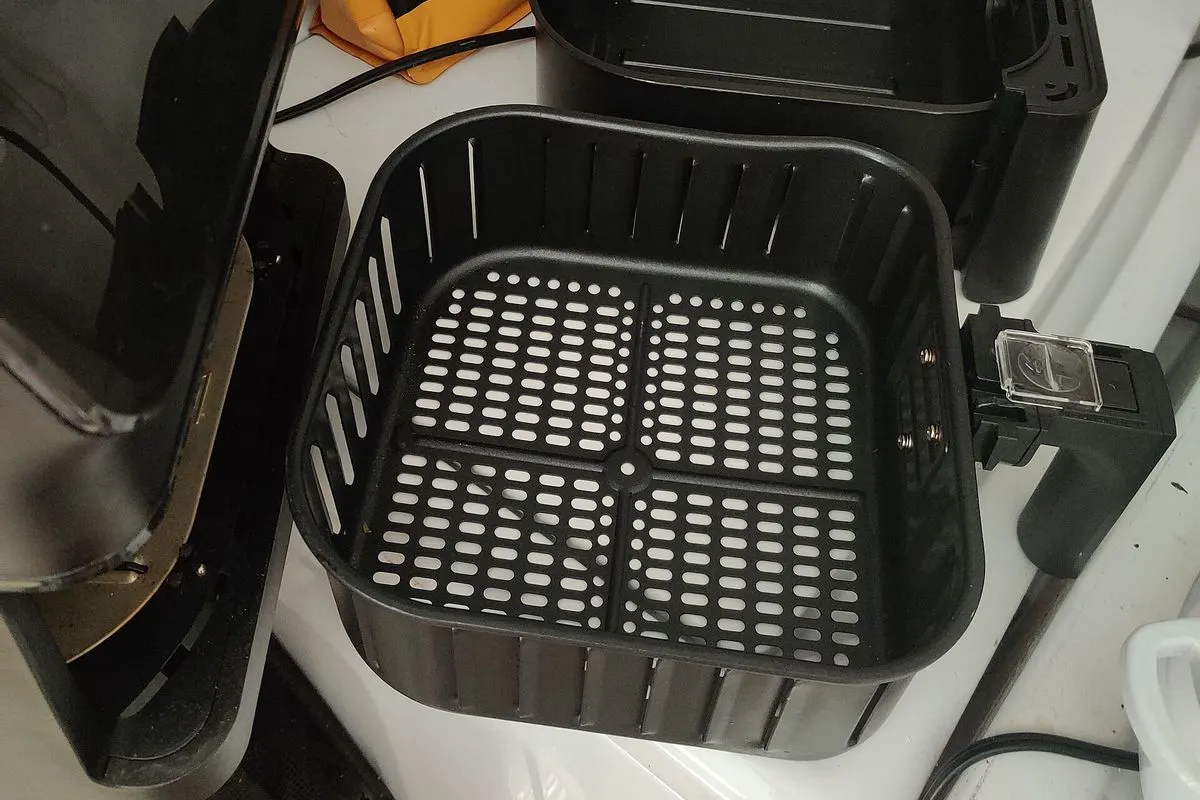
Don’t put wet batter, loose parchment or foil (while preheating), aerosol spray, loose greens or cheese, raw rice, lots of liquid, popcorn, oversized roasts, plastic or paper plates in your air fryer — and don’t let grease build up. Here’s why each one is a problem and what to do instead.
Some of these damage the coating, some set off the smoke alarm, and a few are a real fire risk.
1. Wet batter
Beer-battered fish, tempura and corn dogs made from scratch with a runny batter don’t work. In a deep fryer the hot oil sets the batter instantly. In an air fryer it just drips through the basket and makes a burnt mess.
Do this instead: use a dry breading — flour, egg, then panko or crushed cornflakes. Our crispy chicken tenders show exactly how. Store-bought frozen battered foods are fine because the batter is already set.
2. Loose parchment paper or foil during preheating
An empty air fryer has a powerful fan. A loose sheet of parchment or foil can fly up into the heating element and scorch or even catch fire.
Do this instead: only add liners with food on top to hold them down, and never preheat with them inside. Cut parchment a little smaller than the basket so air still flows.
3. Aerosol cooking spray on a nonstick basket
Some aerosol cooking sprays contain additives that build up into a sticky, gummy layer on nonstick coatings, which can make them peel over time. Many air fryer manufacturers advise against them.
Do this instead: use a refillable oil mister, brush oil on the food, or toss food in oil in a bowl before it goes in.
4. Light, leafy greens (on their own)
Raw spinach, kale or loose lettuce leaves get blown around by the fan and can end up stuck to the heating element, where they burn.
Do this instead: toss kale well in oil (it weighs it down) and use a rack or trivet on top, or cook greens mixed into heavier foods.
5. Loose shredded cheese
Sprinkling cheese straight on the basket or on top of food at the start means it melts through the holes, burns on the bottom, or blows around.
Do this instead: add cheese in the last 1–2 minutes, ideally on food that’s in a dish, or use breaded or frozen cheese snacks that are designed for it.
6. Raw rice, pasta and grains
They need to absorb liquid to cook. An air fryer is dry heat, so they just stay hard (or burn).
Do this instead: cook them on the stove or in a rice cooker. The air fryer is great for reheating leftover rice in a covered dish, or for making crispy pasta chips from cooked pasta.
7. Lots of liquid or sauce
Soups, stews and saucy dishes poured straight into the basket leak out the bottom. Even in a dish, a big amount of liquid takes ages to heat and can splatter onto the element.
Do this instead: add sauces at the end, or use a small oven-safe dish with modest amounts — like our green bean casserole.
8. Popcorn kernels
Most basket air fryers don’t get hot enough, fast enough, to pop corn evenly — and the light popped kernels fly into the heating element. Most manufacturers say not to do it.
Do this instead: use a stovetop pot or a microwave popcorn bowl.
9. Anything too tall
A whole chicken, roast or ham that comes within an inch of the heating element will burn on top and can be a fire risk.
Do this instead: measure your basket. A small turkey breast or small ham fits most 5.8-qt models; bigger cuts need an oven-style air fryer or the regular oven.
10. An overcrowded basket
Technically not dangerous, but it’s the number one reason air fryer food comes out soggy. Food that’s piled up steams instead of crisping.
Do this instead: cook in a single layer with a little space, in batches if needed. Shake halfway.
11. Plastic, paper plates and takeout containers
Plastic containers, foam boxes and paper plates melt, warp or scorch at air fryer temperatures. Some paper can catch fire.
Do this instead: move food onto an oven-safe metal, glass or ceramic dish, or straight into the basket.
12. Very fatty foods without cleaning the drawer
A whole pack of bacon or fatty burgers at high heat drips a lot of grease into the drawer. Old grease plus new grease means smoke — and an angry smoke alarm.
Do this instead: clean the drawer after fatty foods, cook bacon at 350°F (175°C) instead of max heat, and pour off the fat during long cooks. Check your manual — some brands suggest a little water in the drawer to reduce smoke.
Bonus: metal utensils on a nonstick basket
Forks and metal tongs scratch the coating. Use silicone-tipped tongs or wooden utensils.
Allowed after all: myths vs. reality
Lists like this one tend to grow until everything sounds banned. These are fine with the right setup:
| Myth | Reality |
|---|---|
| “Never use foil” | Foil is fine under food, not covering the whole basket floor, and away from the element. Skip it with very acidic foods (tomato, citrus), which can react with aluminum. |
| “Glass dishes will shatter” | Oven-safe glass, like a small Pyrex dish, is fine. The risk is a sudden temperature jump: don’t put a fridge-cold glass dish into a hot air fryer. |
| “Eggs in the shell explode” | Whole eggs in the shell cook fine at about 270°F (130°C) for 15–17 minutes for hard-cooked. Microwaves are the ones that make eggs burst. |
| “Frozen meat must be thawed” | You can cook frozen chicken pieces in an air fryer; it takes about 50% longer, and it’s done at 165°F (74°C). See cooking frozen chicken in the air fryer. Big frozen roasts are the exception: the outside overcooks first. |
| “Parchment will catch fire” | Parchment is rated for oven temperatures. The danger is loose, empty parchment blown into the element, not parchment under food. |
| “No baking” | Small cakes, muffins and hand pies bake well at about 25°F below the oven temperature. Use a pan that leaves 1 inch of space around it. |
How close is too close to the heating element?
Leave at least 1 inch (2.5 cm) between the top of any food, dish or liner and the heating element. To check your machine, take the basket out, turn the unit on its side if needed, and measure from the element down to the rim of the drawer. Many 5–6 qt baskets have about 4–5 inches (10–13 cm) of usable height once you subtract that inch, which is why a 3-lb turkey breast fits and a 6-lb bone-in ham doesn’t.
Food rises, too: biscuit dough, puff pastry and muffins can double in height. Give them the extra room or they’ll stick to the element.
Where the air fryer itself should not go
What goes around the air fryer matters as much as what goes in it. Hot air leaves through vents at the back or top, often at well over 300°F.
- Under kitchen cabinets. The steam and hot air hit the cabinet bottom. Pull it forward so the top is clear; many manuals ask for about 5 inches (13 cm) of space on every side.
- On the stovetop. Someone turns on the burner without looking, and the base melts. It happens often enough that manufacturers warn about it.
- Against the wall or next to paper towels. The back vent needs space.
- On an extension cord or power strip. A 1,700 W air fryer draws about 14 amps at 120 volts, close to the limit of a standard 15-amp circuit. Plug it straight into a wall outlet.
If something catches fire
This is rare, but it’s worth knowing before it happens. Following the NFPA’s cooking fire advice for oven fires:
- Keep the drawer closed. Opening it feeds the fire oxygen.
- Turn it off and unplug it, if you can reach the plug safely.
- Never pour water on it. It’s electrical, and there’s hot grease in the drawer.
- Get out and call 911 if the fire doesn’t go out quickly or spreads beyond the machine.
Afterward, don’t use the machine again. Check the CPSC recalls list with your model number; several air fryer models have been recalled over overheating, and you may be offered a refund or replacement.
Quick cheat sheet
| Avoid | Why | Do this instead |
|---|---|---|
| Wet batter | Drips, burns | Dry breading |
| Loose liners when preheating | Can hit the element | Only with food on top |
| Aerosol spray | Gums up coating | Oil mister or brush |
| Loose greens | Blow into element | Oil + rack |
| Loose cheese | Melts through, burns | Add at the end, in a dish |
| Raw rice/pasta | Needs liquid | Stove or rice cooker |
| Lots of liquid | Leaks, splatters | Sauces at the end |
| Popcorn | Uneven, flies around | Stovetop |
| Tall roasts | Too close to element | Measure first |
| Overcrowding | Soggy food | Single layer |
| Plastic/paper | Melts, scorches | Oven-safe dish |
| Grease buildup | Smoke | Clean the drawer |
Keep this handy: our air fryer cooking times and temperatures chart covers 40+ foods in °F and °C.
FAQ
Can you put aluminum foil in an air fryer?
Yes, as long as it's weighed down by food and doesn't cover the whole basket bottom. Never let loose foil sit in the basket during preheating, and keep it away from the heating element. Avoid foil with very acidic foods like tomatoes or citrus.
Can you put parchment paper in an air fryer?
Yes, with food on top of it. Use perforated air fryer liners or cut parchment smaller than the basket so air can flow. Never preheat with empty parchment inside.
Can you put a glass or ceramic dish in an air fryer?
Oven-safe glass, ceramic and metal dishes are fine if they fit with space around them. Don't put a cold dish from the fridge into a hot air fryer.
Why does my air fryer smoke?
Usually grease from fatty food (bacon, burgers, chicken skin) collecting in the drawer and burning, or old grease from previous cooks. Clean the drawer often and drain fat during long cooks.
Sources
- NFPA: Cooking safety
- U.S. Consumer Product Safety Commission
- USDA FSIS: Safe Minimum Internal Temperature Chart
We check temperatures and safety advice against these official sources. Spotted something wrong? Email hello@shakethebasket.com.